Enablement
Human-agent GTM workflows
Human-agent GTM workflows are the patterns by which people and AI agents divide go-to-market work. Agents handle the repeatable execution (research, inspection, hygiene, drafting, triage) and prepare it for review. Humans manage the last mile: judgment, approval, and every decision that reaches a customer or the CRM. Well-designed workflows make that handoff explicit and governed.
The core principle
Agents do the repeatable work. Humans manage the last mile.
The heart of Agentic GTM is a clear division of labor. Agents are excellent at the repeatable, high-volume, context-heavy work that consumes GTM teams: pulling history, checking fields, drafting outreach, surfacing risk. Humans are irreplaceable at judgment, relationships, and the final decision.
A human-agent workflow makes that division explicit. It defines what the agent prepares, where the work routes for review, and who has authority to approve, edit, reject, or escalate before anything acts on a customer or the CRM.
The traditional handoff problem
In a human-only model, work passes between people through queues, tickets, and inboxes, losing context at every handoff. Nobody is sure what was done, what data was used, or who approved it. Coordination itself becomes the bottleneck.
Human-agent workflows fix the handoff. The agent assembles the context and prepares the work; the operating layer maintains state and routes it to the right person; the human decides. Nothing is lost between agent and human.
How a human-agent workflow is structured
A good workflow reads as a chain of responsibility: the agent prepares, the layer governs, the human decides. Each stage is scoped and observable.
- Trigger — a signal, schedule, or event kicks off the workflow
- Agent execution — the agent gathers context and prepares the work
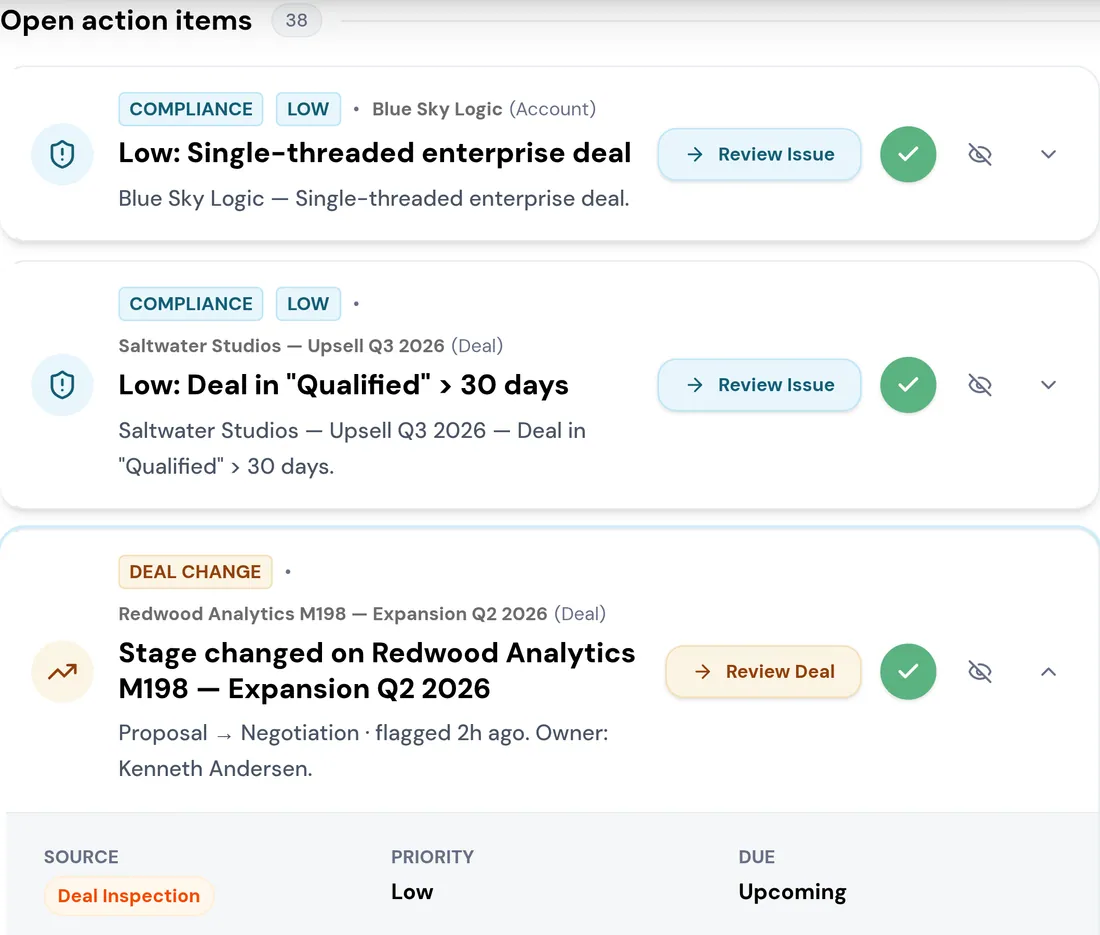
- Review gate — output routes to the right person to approve, edit, reject, or escalate
- Action — approved work is written back or sent under permission
- Audit — every step is logged, attributable, and reviewable
Examples across the GTM organization
The pattern generalizes across every GTM function. In each case, an agent prepares and a human manages the last mile.
- Pipeline inspection — the agent flags risk and gaps; the manager coaches from it
- CRM hygiene — the agent proposes dedupes and enrichment; a human approves
- Lead triage — the agent enriches and routes; humans handle exceptions
- Follow-up — the agent drafts contextual outreach; the rep reviews before sending
- Renewal risk — the agent surfaces exposure and drafts the play; CS decides
Designing effective review gates
The review gate is where control lives. Set gates by risk: high-stakes actions (anything customer-facing or irreversible) require explicit approval, while low-risk, high-confidence work can run with lighter review as trust grows.
RevOps architects these gates as part of the operating model, tuning them over time using agent evaluation and reviewer feedback so teams keep control without becoming a bottleneck.
Common mistakes
Two failure modes bracket the spectrum: too little human control, and too much.
- Letting agents act autonomously on customer-facing work with no review
- Requiring manual approval on everything, recreating the old bottleneck
- Leaving handoffs undefined so context is lost between agent and human
- Never revisiting gates as agent quality and trust improve
Frequently asked questions
Design work for humans and agents
Put governed agents to work on the repeatable execution, and keep your team in control of the last mile.
Try the demo.
See agents carry the repeatable work of GTM across sales, marketing, customer success, and RevOps. Every action prepared, reviewed, and recorded. Fictional data, real product.
Explore the demo