Slide 1 of 4
The library is yours to maintain
Artifacts holds the messaging guides, case studies, value propositions, competitive guidance, playbooks and scripts your team runs on. Agents reference it. They do not fill it in for you.
Treat the artifact library as the campaign's source material, and audit the three artifacts that most determine whether drafted copy is any good.
When the agent drafts a landing page for a target account, it is not inventing your positioning. It is composing from the artifact library, which is described in the product as the operating library you maintain: the messaging guides, case studies, product materials, value propositions and competitive guidance your revenue team runs on. The tour is explicit that agents reference these when they generate work and do not fill the library in for you, so what you put there is what they have.
That has a blunt consequence. If the messaging guide is eighteen months old, this campaign will argue an eighteen-month-old position fluently, on brand, and across every account in the audience. Nothing downstream catches it. The drafts will be internally consistent and wrong, and the reviewer checking them is checking against the same stale source, so the review confirms the error rather than finding it.
This is the failure mode that separates teams who get value from generated content from teams who conclude the output is mediocre. The output is usually a faithful rendering of the inputs. The inputs are what nobody owns.
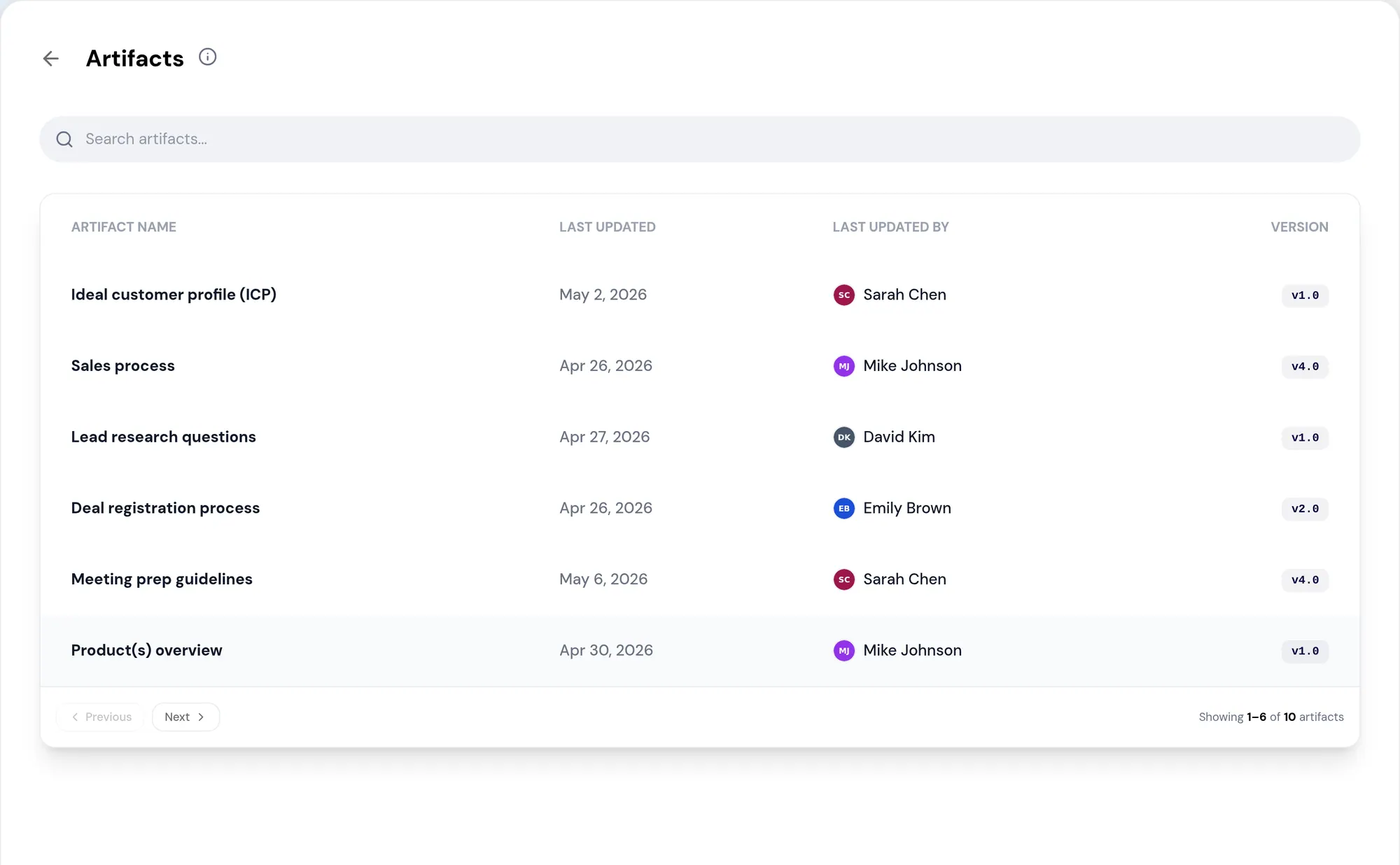
New workspaces start with eight foundational templates: ICP, Sales Process, Lead Routing, Deal Registration, Meeting Prep, Product Overview, Account Plan and Lead Research questions. They exist so the library is not an empty page, and the tour describes them plainly as starting points to fill in and extend.
Teams that treat them as furniture rather than as work end up running campaigns from a half-completed ICP and a Product Overview nobody edited. Before a campaign of any size, three artifacts are worth opening and actually reading, because they determine different things about the copy.
Three are worth opening before a campaign of any size, because each decides something different about the copy, and the third is the one reviewers notice and the hardest to fix one asset at a time.
Each artifact carries an owner, a last-updated date and a version stamp, and every save creates a new version. That turns an otherwise invisible relationship into an auditable one. When drafts change character, you can look at what changed in the library and when, instead of debating whether the output "feels different lately".
It also makes the maintenance rhythm concrete. The highest-leverage artifacts belong on a quarterly review in your operating cadence with a named owner, rather than being edited only when somebody notices the output has drifted. The artifact you publish is the same one referenced from plays, account plans and QBRs, so the effort is not campaign-specific work. It is the thing that keeps every generated surface on message at once.
Twenty minutes before the example campaign generates anything: open the ICP, the Product Overview, and the messaging guidance, and read each against one question: would I sign off on this being argued to 60 accounts this week?
The ICP turns out to describe the enterprise segment you targeted two years ago; the mid-market motion this campaign addresses is a paragraph at the bottom marked "emerging". That gets fixed first, because every asset would have been subtly addressed to the wrong company size. The Product Overview mentions the governance capability the brief leads with only in passing, so one paragraph gets added, with the concrete audit-trail detail the copy will need. The messaging guidance is current. Version stamps update on save, so the campaign record now sits alongside evidence of what the library said at generation time.
Twenty minutes, against the alternative: sixty assets arguing an outdated position fluently, and passing review because the reviewer is checking them against the same outdated source. It is the highest-leverage twenty minutes in the whole campaign.
You should be able to answer each of these from memory before opening it. Recalling the answer is what makes it stick; recognizing it when you read it does not.
Because the reviewer checks the draft against the same source the agent generated from. The copy is internally consistent and on brand by the standard of the stale guide, so nothing looks wrong.
The ICP controls who the copy assumes it is addressing. The Product Overview controls what it claims you do, and it goes stale fastest. The messaging guidance and value propositions control the argument it makes.
Starting points to fill in and extend, so the library is not empty. They are not a finished library, and running a campaign against half-completed ones shows up directly in the copy.
Artifacts holds the messaging guides, case studies, value propositions, competitive guidance, playbooks and scripts your team runs on. Agents reference it. They do not fill it in for you.
An agent drafting a hundred pages has exactly your artifacts to work from. There is no other input to improve.
A stale guide produces fluent, on-brand, out-of-date copy across every account. Review will not catch it, because the reviewer checks against the same stale source.
See agents carry the repeatable work of GTM across sales, marketing, customer success, and RevOps. Every action prepared, reviewed, and recorded. Fictional data, real product.
Explore the demo