Blog
Build a Revenue Downside Scenario Around Shared Dependencies
Test which deals could move together, remove duplicate exposure and connect a downside scenario to a decision before the quarter becomes harder to change.
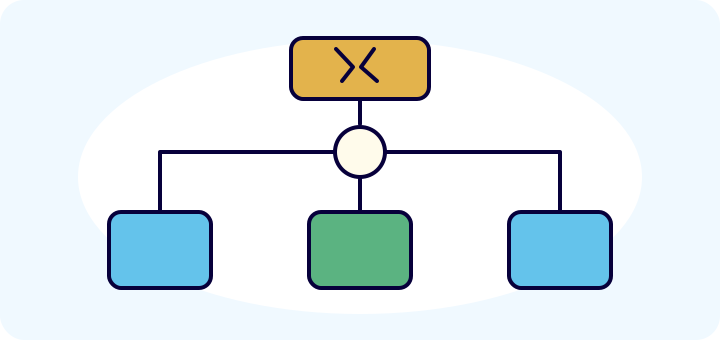
The forecast contains six credible deals. Each seller has a reasonable plan. Three of those plans depend on the same product release, two need the same implementation specialist and one buyer appears in both groups. The opportunity review can be accurate deal by deal while leaving leadership exposed to a single event that moves several outcomes at once.
A revenue downside scenario should identify a shared dependency, change that assumption across the affected deals and show the consequence for the period. Then connect the scenario to a decision the business can still make. Applying a uniform haircut to the forecast may create a lower number, but it does not tell the CRO which assumption matters or what action would improve the situation.
Keep the forecast and the scenario in separate columns
The forecast is the organization's current estimate under its stated method and evidence. A scenario asks what would happen under a defined alternative condition. It can be useful even when nobody believes that condition is the most likely outcome. Keeping the two views separate gives leaders room to prepare without forcing every risk discussion into a debate over the official number.
Name the measure before calculating. This article uses new annual recurring bookings expected to close in a quarter, in one currency. It does not model recognized revenue, cash receipts or a financial accounting forecast. Those measures respond differently to timing and contract terms. Finance should establish the bridge if leadership wants to use the scenario for a broader financial decision.
Current CRM forecast tools can organize deal amounts and categories; HubSpot's documentation describes configurable categories and amount treatment. Those settings do not by themselves establish that your analysis captures common dependencies. The operating question remains: what event could change several included opportunities together?
Find common causes behind different account stories
Look for a dependency that has an identifiable event, owner or decision. A promised capability may need to be ready before multiple buyers can sign. Several deals may rely on the same delivery window. A partner agreement may be required before a set of opportunities can progress. A parent-company budget review may affect several subsidiaries that appear as separate accounts.
Avoid treating a broad label as sufficient explanation. “Market conditions” is usually too vague to guide an immediate action. “Three buyers have told us their committees will wait for a specific funding decision” is a more inspectable hypothesis. The relationship owner should confirm the buyer-facing interpretation; shared industry or geography alone does not prove that outcomes will move together.
Record the source and limits of the connection. Two buyers asking about the same feature does not establish that both will delay without it. One may view it as essential while another sees it as optional. A dependency map should preserve that difference instead of converting a keyword match into a commercial fact.
A fictional quarter with overlapping exposure
Consider a fictional business with $1.8 million already booked this quarter and four open opportunities included in a $3 million management case. The amounts below are single-currency illustrative bookings, not probability-weighted expected values or RevTech customer results.
| Opportunity | Included amount | Condition for this quarter |
|---|---|---|
| Atlas | $400,000 | Release acceptance by the buyer |
| Birch | $300,000 | Release acceptance and an available delivery slot |
| Cobalt | $200,000 | Available delivery slot |
| Delta | $300,000 | Independent procurement decision |
If the release slips beyond the buyers' feasible decision window, Atlas and Birch move out of the quarter in this scenario. Exposure is $700,000, and the scenario becomes $2.3 million. If delivery capacity alone becomes unavailable, Birch and Cobalt move out: $500,000 of exposure and a $2.5 million scenario. These are conditional cases, not assertions that the deals will actually slip.
If both conditions fail, do not add $700,000 and $500,000 and subtract $1.2 million. Birch appears in both groups. The combined affected population is Atlas, Birch and Cobalt, totaling $900,000. The combined downside is therefore $2.1 million: the $1.8 million already booked plus Delta's $300,000 under the stated assumption that Delta closes.
That last assumption matters. Delta is independent of the two named dependencies, not guaranteed. A separate scenario can examine its procurement outcome. “Unaffected by this event” and “certain to close” are different claims. Make that distinction visible so the clean arithmetic does not imply confidence the evidence cannot support.
Choose the decision before adding more cases
A CRO does not need an unlimited menu of lower numbers. The useful scenario is the one that changes a pending operating decision. If the issue is delivery capacity, leadership might decide whether a particular slot can be reserved, whether a qualified alternative can cover the work or whether the customer needs a different start plan. If the issue is release acceptance, Product and Sales need a truthful view of what can be promised.
Consider the example's delivery constraint. Reserving one slot might address Cobalt, but it would not remove Birch's release dependency. The choice should be based on customer commitments, strategic value and feasible work, not merely the largest amount in the exposed list. The scenario reveals the trade-off; it does not make the decision automatically.
Some responses can damage the relationship more than the downside would. Promising an unready capability or manufacturing urgency to pull a signature forward may make the bookings case look better while creating an obligation the organization cannot fulfill. A good scenario conversation leaves space to accept a lower quarter rather than sell an unsupported promise.
Attach triggers to the actions
A scenario becomes operational when it names what evidence will trigger a response and when the decision must be made. “Watch the release” is too loose. A useful condition might be a documented acceptance milestone on a particular date, confirmed by the person accountable for that work. The buyer's remaining decision window should also be checked; an internal release date does not establish the customer's signing timeline.
Separate actions that are sensible now from those that should wait. Preparing an alternative implementation plan may be a reasonable low-regret step. Reassigning scarce specialists may need stronger evidence because it affects other customers. The difference helps leadership prepare without repeatedly reorganizing the business around every possible outcome.
Give each action one accountable owner and preserve its assumptions. At the next review, ask what changed in the dependency, not simply whether the forecast number moved. An opportunity may remain in the same category while the time available to resolve its common condition shrinks. That shrinking window can be the reason to decide now.
Use analysis to expose concentration, not manufacture probabilities
RevTech's Analyst Agent prepares answers to recurring revenue questions with supporting evidence. In an agreed workflow, that can help a team review the opportunity population and changes in recorded conditions. Prepared account context and recurring analysis support the review; neither supplies an accuracy guarantee. A custom dependency or scenario method needs confirmed inputs and scope.
Do not imply that a verified correlation engine or portfolio simulation capability exists simply because a prepared analysis can group records. The starting output can be a plain table: common condition, affected opportunities, nonduplicated amount, evidence date and question for the owner. The CRO decides which assumptions belong in the scenario and which actions follow.
If probabilities are unavailable or poorly calibrated, leave the cases conditional. “If this release misses the usable date, these opportunities are exposed” can support a real decision without a fabricated thirty-seven percent likelihood. More numerical detail is only helpful when the evidence deserves it.
Bring one common dependency to the next forecast review
Ask managers to identify one event outside an individual seller's control that could affect several deals in the current period. Validate the affected population with account owners, calculate the exposure once per opportunity and write the resulting decision in ordinary language. Preserve the original forecast alongside the scenario.
After the period closes, compare the assumptions with what happened. Did the dependency matter? Did the chosen response address it? Were opportunities grouped together for a reason that turned out to be weak? That review improves the next operating decision. It should not turn a scenario into a retrospective prediction contest.
Sources and scope
The dependency method and all amounts are original illustrations, reviewed October 16, 2026. The source material supports forecast-tool and product boundaries, not the fictional outcomes.
- HubSpot, Set up the forecast tool: https://knowledge.hubspot.com/forecast/set-up-the-forecast-tool
- RevTech Analyst Agent: https://revtech.ai/ai-agents/analyst
- RevTech Revenue Intelligence: https://revtech.ai/platform/revenue-intelligence
Put the framework to work
Explore the operating model.
Choose a defensible forecast method
Keep the core forecast tied to available evidence.
ExploreResolve forecast disagreement
Inspect a seller and model difference at deal level.
ExploreExplore Revenue Intelligence
Review evidence-led revenue questions.
ExploreSee the Analyst Agent
Understand scheduled analysis and its supporting records.
ExploreHubSpot forecast configuration
Primary source checked October 16, 2026; supports the limited point described in this article.
ExploreKeep reading.
A Discount Exception Needs a Decision Brief
Give a CRO the buyer evidence, full concession, alternatives and conditions needed to decide a discount exception without reconstructing the deal.
Read
Plan Renewal Capacity Before the Calendar Gets Crowded
Translate renewal dates into the weeks when preparation, customer conversations and commercial reviews need capacity, with a worked planning example.
ReadSee how the work gets done.
Explore how agents prepare work across your revenue teams, and how people review it, guide it and decide what happens next. Fictional data. Real product.
Explore the demo