Buyer comparison
CRM-native AI skills vs. fully managed cross-GTM agents
CRM-native AI skills give an assistant governed access to records, actions and workflows inside a CRM ecosystem. Fully managed cross-GTM agents address a different operating question: who designs, runs, evaluates, governs and recovers the revenue workflow across systems. RevTech runs the agents; customers govern objectives, permissions, approvals and business decisions.
Published
Definitions
Access is a capability. Operating ownership is a model.
Salesforce and Anthropic announced Salesforce in Claude with 37 prebuilt sales skills for activities such as meeting preparation, deal-health review and pipeline review. Salesforce describes those skills as grounded in live revenue context and routed through Salesforce rules and governed workflows.
That announcement makes CRM-native skills a serious option, not a straw man. The buyer decision is whether governed access inside a CRM is enough for the intended work, or whether the organization also needs a managed owner for cross-system workflow design, production operations, evaluation, exceptions and continuous improvement.
Sources:Salesforce and Anthropic announce ClaudeforceAnthropic and Salesforce partnership
Architecture
Compare where the workflow starts, ends and gets governed
A CRM-native skill begins with the permissions, data model, business logic and actions of its CRM environment. A managed cross-GTM agent can use the CRM as the system of record while coordinating approved context and work across the broader revenue stack.
Neither architecture is universally better. The right boundary depends on the systems involved, the consequences of the action, the amount of human judgment required and who will own steady-state operations.
| CRM-native skills | RevTech | |
|---|---|---|
| Primary boundary | The CRM ecosystem and the actions it exposes. | The approved GTM workflow across CRM, context, agents and human review. |
| System of record | CRM data and business rules stay central. | The CRM also remains the system of record. |
| Orchestration | Skills are invoked where the assistant or CRM experience runs. | Managed workflows coordinate bounded steps, evidence and review across the agreed process. |
| Governance | CRM permissions and platform controls govern available actions. | Customer policies govern permissions, approvals and scope inside the managed operating layer. |
| Operating owner | The customer and platform share configuration responsibility. | RevTech runs the agents and operating system; the customer governs the business. |
Workflow coverage
Test the whole job, not the most impressive step
Map the work from trigger to evidence-backed completion. A useful comparison includes context assembly, action preparation, required approvals, write-back, exception handling and the outcome review—not only the moment an assistant produces an answer.
- 01
Trigger
Name the event or condition that starts the work.
- 02
Context
List every approved record, definition and policy the work needs.
- 03
Prepare
Define what the skill or agent may research, draft or change.
- 04
Approve
Route consequential work to the accountable person with evidence.
- 05
Complete
Record the action, status and resulting system changes.
- 06
Improve
Review edits, exceptions and outcomes against acceptance criteria.
Total work
Make invisible operating work visible
A feature comparison usually undercounts the work that begins after access is granted. Use this matrix to expose internal ownership before selecting an architecture.
| Use case | CRM-native question | Managed-agent question | Evidence to request |
|---|---|---|---|
| Implementation | Who configures each skill and action? | Who designs and deploys the end-to-end workflow? | Named implementation owner and acceptance test |
| Context | Which CRM objects and rules are available? | How is cross-GTM context maintained? | Source map, refresh owner and definitions |
| Permissions | Which platform permissions constrain actions? | Which customer policies and approval gates apply? | Role, object, field and action matrix |
| Quality | Who evaluates skill output? | Who operates evaluation and controlled improvement? | Evaluation set, release gate and feedback loop |
| Recovery | Who handles a failed or partial action? | Who owns retries, exceptions and remediation? | Failure states, escalation path and recovery owner |
| Outcomes | How is usage measured? | How is trustworthy completion tied to a GTM result? | Baseline, workflow KPI and business KPI |
Buyer scorecard
Choose the smallest operating model that can safely finish the work
Score each criterion from 1 to 5 and attach evidence. A high feature score cannot compensate for an unowned production responsibility.
- The full workflow boundary is explicit, including every system and human decision.
- A named owner exists for context, evaluation, permissions, operations and recovery.
- Consequential actions stop at documented approval gates.
- The operator can show evidence for what happened, why and under which policy.
- Failures are bounded, visible and recoverable without guessing.
- The success measure is workflow completion and commercial outcome, not skill usage alone.
Frequently asked questions
Compare the ownership boundary.
Bring one revenue workflow. Map who owns every step from trigger through recovery before comparing feature lists.
Try the demo.
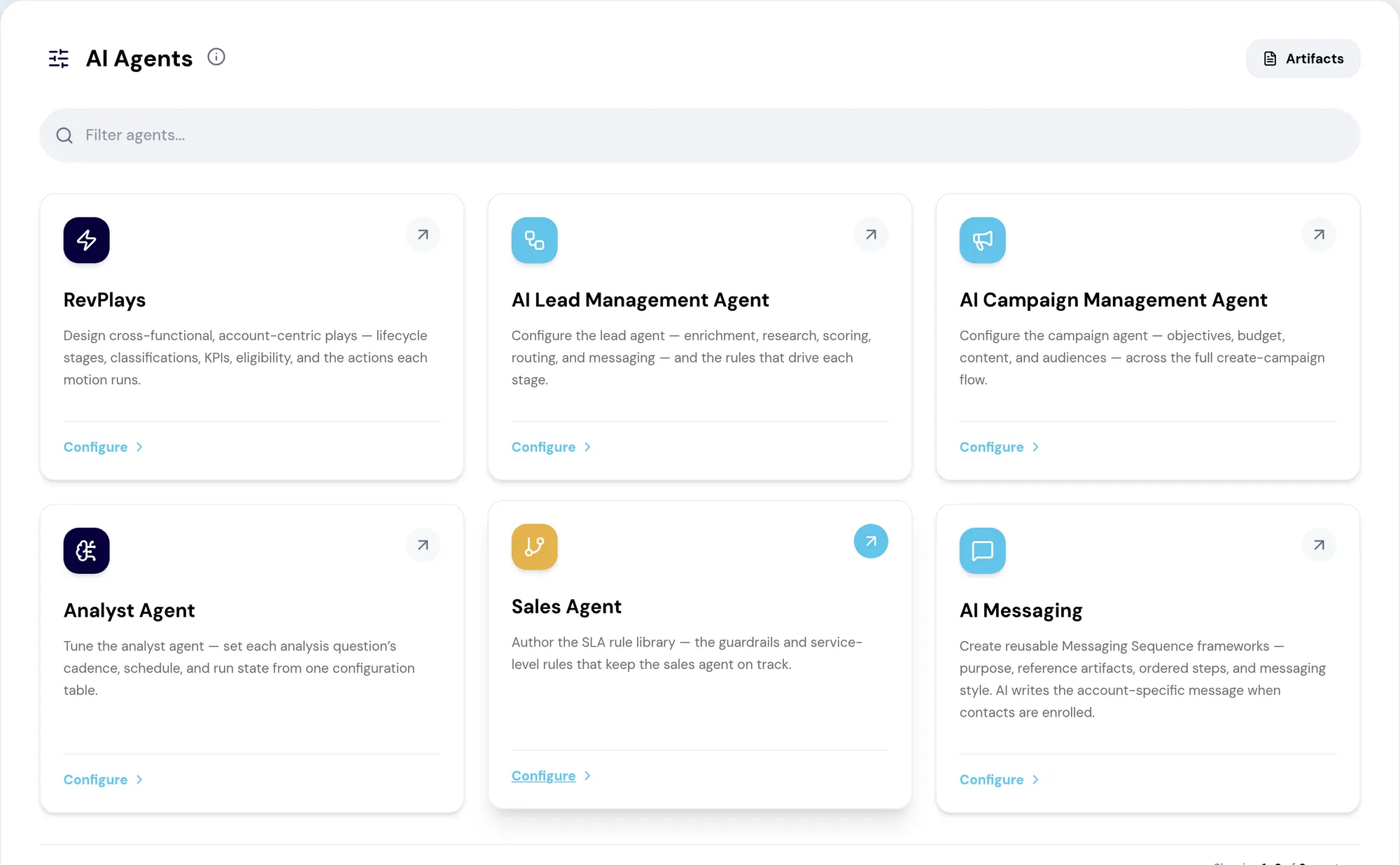
See agents carry the repeatable work of GTM across sales, marketing, customer success, and RevOps. Every action prepared, reviewed, and recorded. Fictional data, real product.
Explore the demo