Slide 1 of 5
Two fields, two jobs
The Strategy step asks for a brief and a set of objectives. People treat them as one thing. They are not, and mixing them up costs you either the copy or the measurement.
Fill in the Strategy step correctly: prose in the brief, numbers in the objectives, and know which of the two decides whether your copy is any good.
Naming the campaign and placing it in a program happens in a modal; the builder proper opens after that, and its first labelled step is Strategy. Strategy collects two different kinds of thing. There is a rich-text brief, whose placeholder tells you exactly what belongs in it: describe the goal, the messaging, and the target audience. Then there is a block called Campaign Objectives, which is not prose at all. It is five numeric fields: Leads, Meetings and Deals as counts, Revenue and Influence in currency.
This trips people up because "objective" in ordinary marketing usage means a statement of intent, and here it means a number. Someone who has been told the objective is what the agent writes against will look for a large text box labeled objective, find five inputs defaulting to zero, and either type prose into the brief without realizing that was the field that mattered, or leave the targets blank because they read as optional.
Both mistakes are quiet. Neither produces an error. The campaign runs, the assets generate, and the consequences show up weeks later in two separate places.
Everything the agent drafts for this campaign is generated against the brief. So the difference between describing an activity and describing an outcome decides the quality of every asset. Only one of them tells the agent what a good landing page has to argue.
"Q3 awareness push" names something the marketing team is doing. It contains no audience, no objection and no argument. "Convince platform engineering leaders at mid-market SaaS accounts that consolidating tooling is lower risk than it looks" names a result, and in doing so it specifies who is being addressed, what they currently believe, and what the copy has to overcome. The second brief produces usable assets. The first produces assets that could belong to any vendor in your category.
The most reliable route there is to write the belief you are trying to move. Answer three questions and the argument falls out of the gap between them.
Naming that gap gives you something to review against later that is not a matter of taste. When a draft comes back, the question stops being whether you like the wording and becomes whether the page moves a reader from the first belief to the second. Marketing teams can agree on that question. They rarely agree about wording.
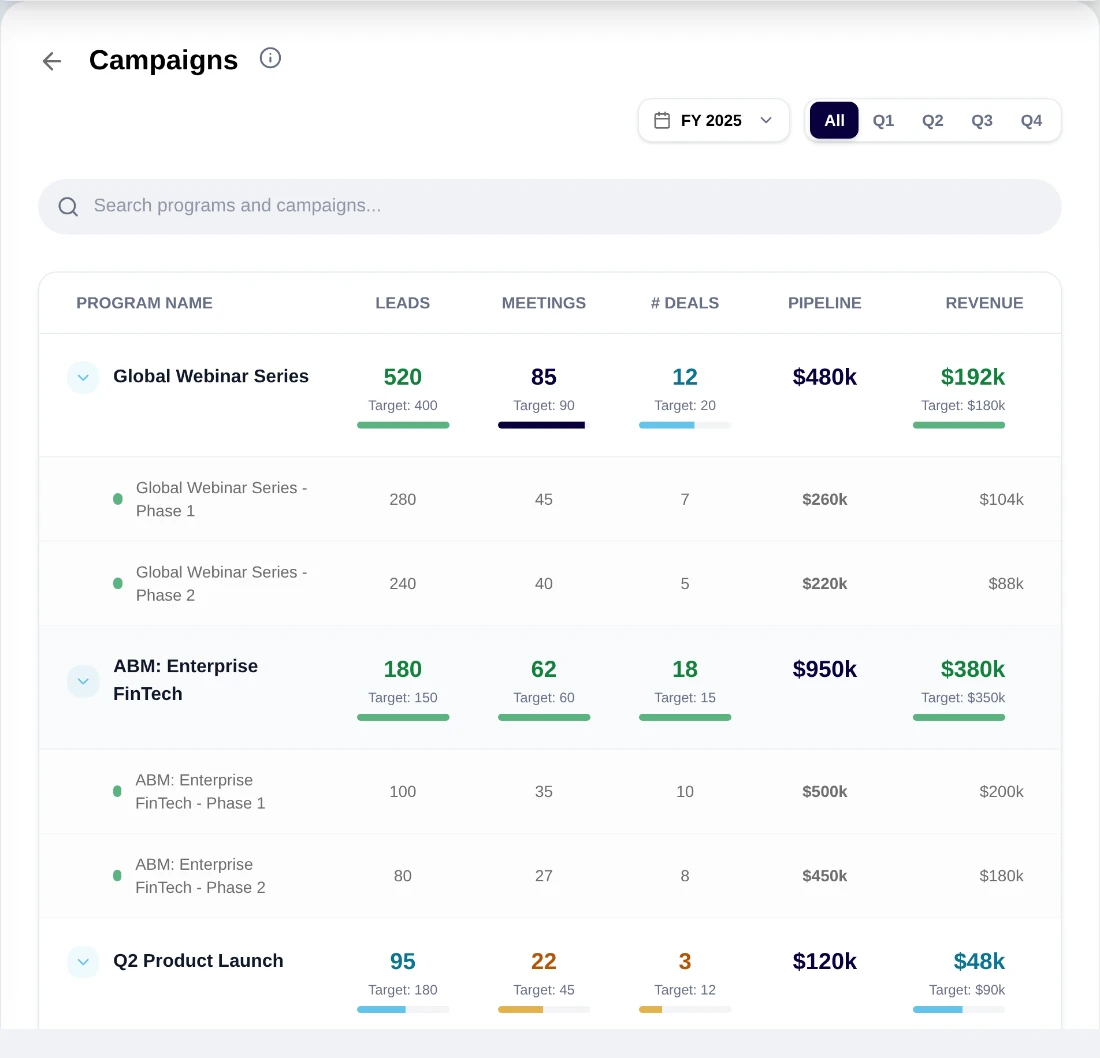
The five numeric fields do a different job, and it is worth being deliberate about them because they are the terms of your own assessment. The campaigns report shows every program and campaign on the same basis: leads, meetings, deals, pipeline and revenue. Those columns line up with what you enter here. Setting a target is choosing the line someone will hold you to at the review.
Leaving them at zero does not spare you the assessment. It just means the campaign gets compared to other campaigns on raw volume, which systematically flatters whichever campaign was biggest. A modest, well-targeted campaign with no stated objective looks worse than a sprawling one, and there is nothing in the record to argue with.
Influence is the field most often left blank and the one worth thinking hardest about, because it is where campaigns that support pipeline rather than creating it can state what they were actually for. A campaign designed to unstick late-stage deals will never look impressive on Leads, and it should not have to.
A vague brief does not produce visibly broken output. It produces copy that is grammatical, on-brand and entirely generic. That is a worse outcome than a broken draft, because a broken draft gets rejected and a bland one gets approved by a reviewer who cannot point at anything wrong with it.
So run the check here, before anything is generated. Read your brief and ask whether a competitor could have written the same sentences about their own campaign. If they could, your assets will be interchangeable with theirs, and no amount of reviewing at the other end will fix what is a specification problem at this one.
Here is a complete brief of the kind that produces usable assets, for a fictional campaign. Read it as a template; every sentence is doing a specific job.
"Audience: heads of revenue operations at mid-market B2B SaaS companies (200–1,000 employees) currently running their GTM reporting across spreadsheets and three or more point tools. Current belief: consolidating onto an operating platform is a year-long IT project with high migration risk, so the spreadsheets survive another quarter. Target belief: the operating layer sits on top of their existing CRM rather than replacing it, so the risk they are pricing in does not exist. Messaging: lead with the CRM-stays-the-system-of-record architecture; use the governance and audit-trail capability as proof this is enterprise infrastructure, not a productivity tool. Do not lead with AI novelty. Tone: direct, operational, no hype."
Notice what is in it: a specific audience, the belief being moved from and to, the argument that moves it, the evidence to lead with, and a negative instruction (what not to lead with). Notice also what is absent: no finished copy, no slogans, no feature list. The agent writes the copy; the brief tells it what the copy must accomplish. If your brief reads like ad copy, it is doing the agent's job badly instead of its own job well.
For the same campaign, defensible numeric objectives might be: Leads 120, Meetings 25, Deals 8, Revenue 640,000, Influence left at zero because this is a demand campaign rather than an acceleration one. Where do numbers like that come from? Backwards from the one that matters: if the campaign exists to source eight deals and your funnel history says a deal needs roughly three meetings sourced and a meeting needs roughly five qualified leads, the upstream targets follow. Write the chain down next to the campaign so the review can test the assumption that broke, not just the number that missed.
The mistake to avoid is entering aspirational round numbers with no chain behind them, like 500 leads because it sounds substantial. The report will dutifully compare actuals against them, and the comparison will be noise.
You should be able to answer each of these from memory before opening it. Recalling the answer is what makes it stick; recognizing it when you read it does not.
The brief. Its placeholder asks for the goal, the messaging and the target audience. Campaign Objectives is five numeric fields (Leads, Meetings, Deals, Revenue, Influence) and does not feed generation at all.
The campaign still runs, but it gets compared to other campaigns on raw volume, which favors whichever campaign was largest. You lose the ability to argue that a small, targeted campaign did what it set out to do.
Whether a competitor could have written the same sentences about their own campaign. If so, the output will be interchangeable with theirs, and reviewing harder later will not fix it.
The Strategy step asks for a brief and a set of objectives. People treat them as one thing. They are not, and mixing them up costs you either the copy or the measurement.
Its placeholder tells you the scope: describe the goal, the messaging, and the target audience. This is the text the agent generates every asset against.
The campaign report measures leads, meetings, deals, pipeline and revenue. Setting a target here is choosing the line you will be held to later.
produces assets a competitor could have shipped. This is the single highest-leverage text box in the campaign, and the one most often filled in last.
See agents carry the repeatable work of GTM across sales, marketing, customer success, and RevOps. Every action prepared, reviewed, and recorded. Fictional data, real product.
Explore the demo