Enablement
Agentic GTM: architecture, use cases and a 90-day plan
Agentic GTM is a go-to-market operating model where fully managed AI agents execute repeatable work across sales, marketing, customer success and RevOps while people govern the decisions. The architecture connects systems of record, shared GTM context, specialized agents, approval gates and measured outcomes. Teams can adopt it in 90 days by starting with one bounded workflow and widening only after evidence supports it.
The definition
A new operating model, not another tool
Agentic GTM is the shift from a human-only go-to-market motion to one where specialized AI agents and people operate together. Instead of adopting AI as a feature bolted onto existing tools, GTM organizations redesign how work actually gets done: agents take on the repeatable, high-volume execution, and humans focus on judgment, relationships, and the last mile.
The category is bigger than any single agent or automation. Agentic GTM is an operating model: a coordinated system spanning your CRM, GTM data, models, agents, workflows, governance, and human review. RevTech is the enterprise-grade agentic operating layer that makes it possible.
Architecture
The six layers of an agentic GTM system
Agentic GTM does not replace the CRM. It adds a managed system of work above the systems that already store customer and pipeline truth. Each layer has a different job, and the governance layer spans every transition.
- 01
Systems of record
CRM and approved GTM systems remain the source of business truth.
- 02
Context layer
Definitions, process rules, account context and permissions ground the work.
- 03
Managed agents
Specialized agents inspect, research, prepare and coordinate repeatable tasks.
- 04
Governance gates
Policies, thresholds and scoped access determine what can move forward.
- 05
Human review
People approve, edit, reject or escalate work at the last mile.
- 06
Measured outcomes
Workflow quality and business KPIs determine whether scope should widen.
Managed agents and DIY agents are different operating choices
A model and a workflow builder are ingredients, not an operating model. The decision is whether your team will assemble, test, monitor and maintain the agents itself or govern a managed service that runs them with you.
| DIY agent stack | RevTech | |
|---|---|---|
| Build ownership | Your team designs prompts, integrations, routing and retries. | RevTech runs and maintains the agent system. |
| Business context | Your team translates process and policy into every workflow. | Shared GTM context grounds agents across workflows. |
| Governance | Controls are assembled beside each workflow. | Permissions, approvals and audit are part of the operating layer. |
| Change management | Operators diagnose and repair drift themselves. | RevTech manages the agents; your team governs outcomes and scope. |
| Success measure | The agent runs. | The workflow produces reviewable GTM outcomes. |
Use cases
Start where the work is repeatable and the decision is clear
The best first workflows have stable inputs, a visible owner and an output a person can inspect. They create enough repetition to learn quickly without handing an agent an ambiguous mandate.
| Use case | Agent work | Human gate | Workflow KPI |
|---|---|---|---|
| Pipeline inspection | Review open opportunities for missing context and risk. | Manager confirms intervention. | Coverage, accepted findings, next-step completeness. |
| CRM data maintenance | Propose corrections, enrichment and deduplication. | Owner approves record changes. | Acceptance rate, freshness, exception volume. |
| Lead triage | Gather context and prepare a routing recommendation. | Operator reviews exceptions. | Response time, correct routing, exception rate. |
| Account planning | Assemble account context and prepare a working plan. | Account owner edits priorities. | Plan coverage, edit rate, action completion. |
| Customer risk review | Organize health signals and prepare an escalation brief. | CS owner chooses the response. | Review coverage, accepted risks, action follow-through. |
| Campaign preparation | Prepare audiences, briefs and review-ready work products. | Marketing approves launch inputs. | Cycle time, approval rate, rework. |
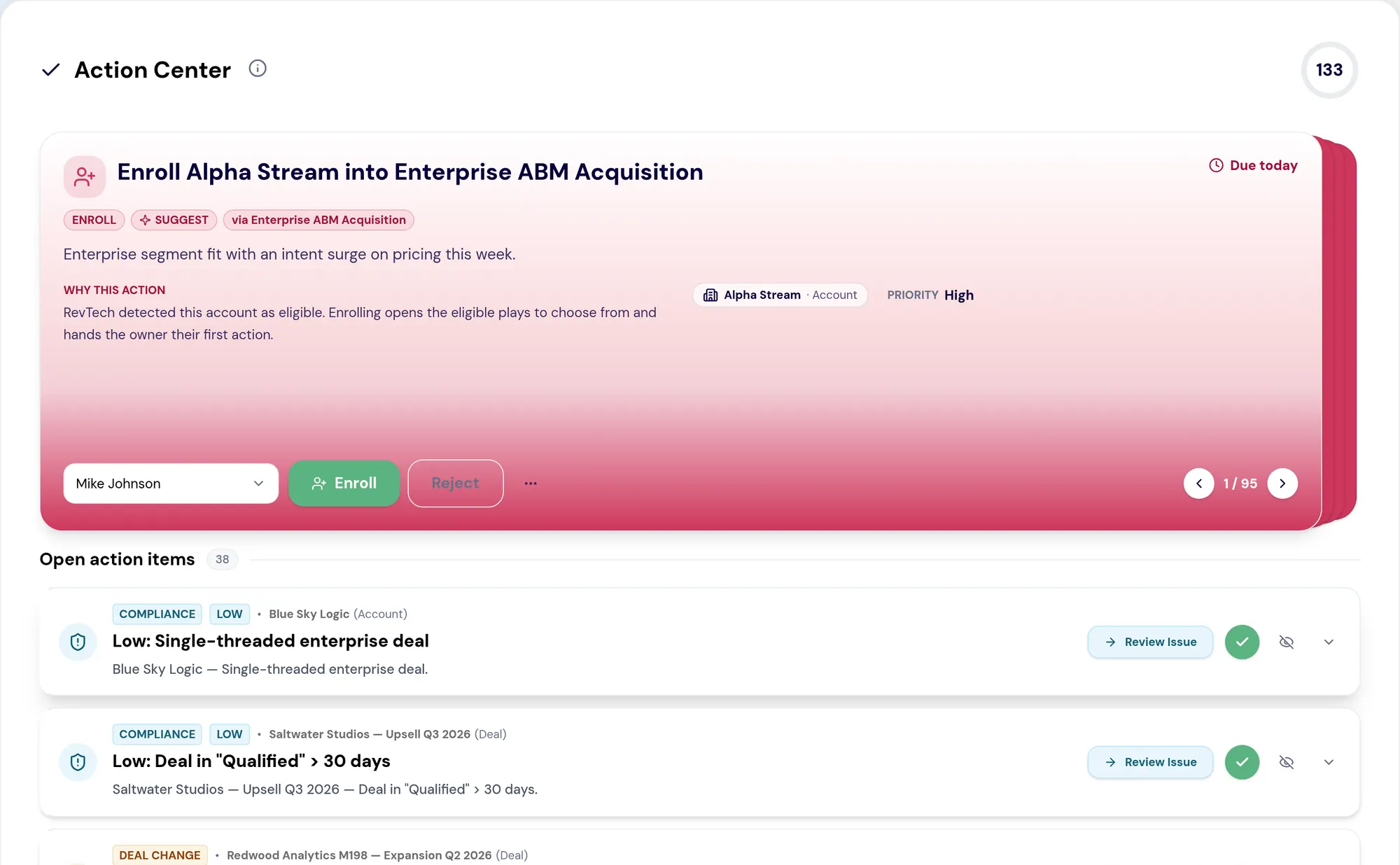
Readiness scorecard
Five questions to answer before the first workflow runs
A team is ready when the workflow can be described more clearly than the technology. If any answer is missing, use the first 30 days to define it rather than letting the agent discover policy by accident.
- Objective — can the team state the business decision this workflow should improve?
- Inputs — are the required records, fields and definitions known and accessible?
- Owner — is one person accountable for reviewing output and resolving exceptions?
- Guardrails — are permissions, approval thresholds and prohibited actions explicit?
- Measurement — can quality, coverage, cycle time and business impact be reviewed together?
90-day plan
Adopt the operating model in three controlled phases
The sequence matters more than the calendar. Ground the system first, run a bounded workflow under full review, and widen only when the evidence supports more coverage or autonomy.
Days 1–30
Ground and govern
Choose one workflow, connect approved data, define context, assign the owner and set every output to human review.
Days 31–60
Run and learn
Operate against real work, record approvals and edits, review exceptions weekly and repair context before expanding scope.
Days 61–90
Prove and widen
Compare outcomes with the baseline, formalize the operating cadence and extend coverage only where quality is consistent.
Measure the workflow, not the novelty
Agent activity is not the outcome. Track whether the operating model improves coverage, execution quality, decision speed and business results—and whether humans accept the work with less editing over time.
- Coverage — the share of eligible work the agent reviewed or prepared
- Quality — acceptance, edit, rejection and exception rates
- Latency — time from signal to review-ready work
- Control — approval compliance and unresolved exceptions
- Outcome — the workflow-specific business KPI the team chose at the start
Frequently asked questions
Make GTM AI-native
Stop adopting AI and start working with agents. See how the agentic operating layer puts governed agents to work across your GTM organization.
Try the demo.
See agents carry the repeatable work of GTM across sales, marketing, customer success, and RevOps. Every action prepared, reviewed, and recorded. Fictional data, real product.
Explore the demo