Blog
Test a revenue workflow change with a credible comparison
A better result from the pilot team may reflect who joined the pilot.
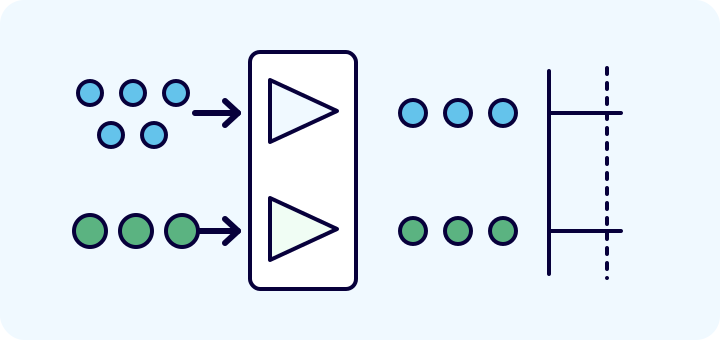
The pilot team accepts more prepared account briefs and closes more business than the rest of Sales. The rollout is declared a success. The pilot also had the most experienced manager, the cleanest account records and a concentrated group of late-stage deals. The result is encouraging, but it has not isolated what the new workflow changed.
Design the comparison before the rollout. Define who is eligible, what changes, which outcome the workflow can reasonably influence and how the comparison group differs. Use a feasible assignment method and a shared observation window. Where the design cannot support a causal conclusion, report a bounded operational finding instead of converting a favorable result into proof.
Choose an outcome close to the work
A preparation workflow might first be evaluated on whether the intended recipient can use the brief, how much correction is needed and whether the agreed review happens. Revenue outcomes can matter later, but they are influenced by buyer readiness, deal mix and many other decisions.
Choose one primary question. For example: “Does the new preparation reduce the manager’s total review effort while preserving the evidence needed to make the decision?” Measure the full work, including corrections and any manual preparation that remains. A shorter generation time does not answer that question.
Set unacceptable trade-offs in advance. Faster review is not a pass if material source errors increase or customer commitments become less visible. The decision rule should include quality and practical usability, not just a favorable average.
Compare like work under a defensible assignment
Where practical and appropriate, random assignment among eligible units can help reduce systematic differences between groups. NIST’s experimental-design guidance describes randomization and blocking as tools for handling variation. Applying those ideas to revenue work still requires care: people learn from each other, accounts differ and a customer should not lose a required service merely to create a comparison.
Choose the assignment unit that fits the workflow. If one manager reviews every brief for a team, randomly switching individual accounts may create contamination as the manager carries new habits across groups. A team-level comparison can reduce that problem but may leave very few independent groups. Do not treat hundreds of briefs as hundreds of independent managers.
If random assignment is not feasible, choose a comparison with similar motion, account mix, staffing and timing, and document the remaining differences. A matched comparison is useful evidence but does not automatically remove selection bias. Expert design help is appropriate when the commercial decision depends on a strong causal claim.
A fictional comparison changes the conclusion
Suppose twelve sellers volunteer to use a new brief. Their average review time is eight minutes, compared with twelve minutes for nonparticipants. It is tempting to call that a four-minute improvement.
Baseline observations show the volunteers already averaged nine minutes, while the comparison group averaged thirteen. Each group improved by one minute during the observation period. The four-minute difference after rollout mostly reflects a difference that existed before it. These fictional numbers demonstrate why a post-change comparison alone can mislead; they do not establish that a before-and-after adjustment proves causality.
The team also discovers that volunteers worked fewer complex accounts. It separates the relevant account types, includes correction effort and asks whether the workflow is useful for the intended broader population. The result may still justify expansion, but the rationale becomes narrower and more honest: usable preparation in the tested scope, with complex-account coverage unresolved.
Keep the calendar and missing cases visible
Give groups comparable time to receive and use the work. A new cohort observed for one week cannot be compared fairly with a group that has had a month to complete its follow-through. Record eligibility, participation, missing outputs and unavailable feedback rather than analyzing only successful completions.
Preserve the rollout date and relevant process changes. If a new manager, pricing policy and workflow all arrive together, the observed movement cannot be assigned confidently to the workflow alone. That limitation belongs in the decision record, not in a footnote added after the result is praised.
Avoid repeatedly checking a noisy metric and stopping the test the first time it looks favorable. Agree the observation period and review method in advance, with explicit reasons for an early safety or quality stop.
Make the next commitment fit the evidence
The outcome can be expand, narrow, revise, gather missing evidence or stop. A small operational test may justify a larger controlled rollout without supporting a company-wide ROI claim. An inconclusive result is useful when it identifies the uncertainty the next step must resolve.
RevTech can help prepare agreed recurring evidence from connected CRM sources. The customer and operator still need to define the comparison, preserve the relevant baseline and collect human usability feedback. This article does not imply a built-in randomized experimentation platform.
Before launching the next workflow change, write the result that would make you stop as clearly as the result that would make you expand. That simple discipline helps turn a pilot from a demonstration of enthusiasm into a decision the organization can defend.
Put the framework to work
Explore the operating model.
Midquarter sales process change
Learning design and comparability before expansion; canonical owns effective-date transition and historical policy.
ExploreRevTech for RevOps
Review the current scope and responsibilities relevant to this article.
ExploreAnalyst Agent
Review the current scope and responsibilities relevant to this article.
ExploreNIST: Randomized block designs — checked October 23, 2026
Primary source for the specific factual context identified in the article.
ExploreNIST: Completely randomized designs — checked October 23, 2026
Primary source for the specific factual context identified in the article.
Explore

See how the work gets done.
Explore how agents prepare work across your revenue teams, and how people review it, guide it and decide what happens next. Fictional data. Real product.
Explore the demo