Pricing buyer guide
Revenue AI agent pricing models explained
Revenue AI agents are commonly priced by seat, usage, managed service or a hybrid. The useful comparison is total cost per trustworthy completed workflow: vendor spend plus implementation, internal operations, evaluation, governance, exception recovery and change management. Compare the same production scope with your own assumptions.
Published
Pricing models
The unit of price changes what the vendor optimizes
A seat price is easy to budget but can hide whether the system performs work or only gives a person access. Usage pricing aligns spend to consumption but needs a clear definition of the metered unit. A managed-service agreement can include operating responsibility, but the scope and customer governance duties must be explicit.
| Use case | What is metered | Useful when | Question to ask |
|---|---|---|---|
| Per seat | Access for each user | Human usage is the main value driver | What production agent work occurs without a user operating the tool? |
| Usage or credits | Runtime, actions, tasks or another consumption unit | Work volume varies and usage is observable | What consumes the unit, expires, rolls over or requires a higher commitment? |
| Managed service | Defined scope, capacity or operating agreement | The buyer wants an accountable operating owner | Which design, QA, monitoring, recovery and improvement duties are included? |
| Hybrid | A base commitment plus usage or services | The workload has stable and variable components | How do minimums, overages and scope changes affect total cost? |
RevTech pricing
RevTech prices agentic runtime, not seats
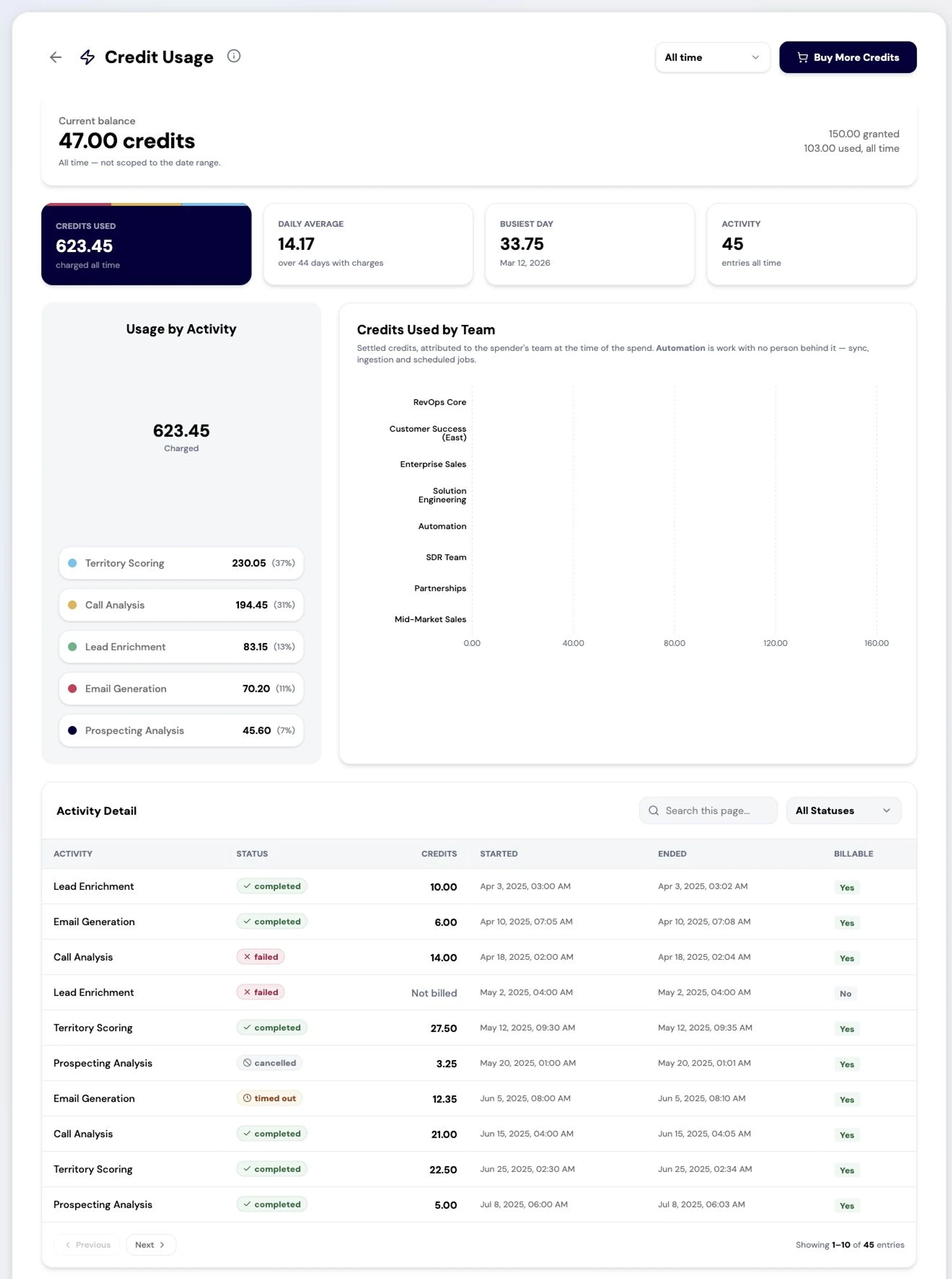
RevTech’s current sales-led offer starts from $499 per month for 500 credits. A credit is a bundle of agentic runtime covering work such as execution, model usage, context assembly, tool calls, orchestration, human-review workflows, logging and observability. Simple and complex actions can consume different amounts.
Larger committed volumes are priced through an annual agreement. RevTech does not publish a volume rate card because the agreement depends on the planned agents, workflows, teams, data volume and execution frequency. Professional services beyond general product support are quoted separately.
- No seat licensing and no separate platform fee in the current model.
- Self-service is not currently live; every new account starts through a sales conversation.
- Included credits, purchased credits and enterprise commitments can carry different expiry terms.
- Use the current pricing page and agreement for authoritative commercial terms.
Hidden operating work
List the work that survives the purchase order
A low visible price can still produce a high operating cost when the customer must design integrations, maintain context, build evaluations, review incidents and staff a change queue. A higher visible price can still be poor value if its managed boundary is vague.
Keep one-time implementation, recurring vendor spend and recurring internal work separate. Then compare the same workflow volume, evidence standard, approval model and recovery expectation.
| Use case | One-time cost | Recurring cost | Evidence to collect |
|---|---|---|---|
| Integration and context | Connection, mapping and source validation | Refresh, permission and schema maintenance | System inventory, owner and change process |
| Workflow design | Policy translation and acceptance criteria | Rule, prompt and process changes | Versioned design and accountable owner |
| Evaluation | Test-set and release-gate design | Regression review and quality tuning | Metrics, thresholds and change log |
| Governance | Approval and permission design | Policy reviews and audit evidence | Decision matrix and evidence retention |
| Recovery | Exception and rollback design | Monitoring, retries and incidents | SLA, escalation and recovery owner |
| Adoption | Pilot and enablement | Feedback, training and operating reviews | Adoption owner and review cadence |
Procurement checklist
Compare cost per trustworthy completed workflow
The denominator matters. A cheap action that requires manual repair is not equivalent to a completed workflow with evidence, approved changes and a recovery path. Define completion before dividing cost by volume.
- Define the workflow boundary and what counts as trustworthy completion.
- Record included usage, overage rules, minimum commitments, expiry and cancellation terms.
- Separate platform, model, integration, services and internal labor costs.
- Name the owners for context, evaluation, governance, exceptions and improvement.
- Use buyer-supplied labor and volume assumptions; do not accept invented ROI inputs.
- Review business outcomes separately from service activity and avoid unsupported causation.
Total operating cost
Compare the same production scope.
Enter your own commercial and labor assumptions. The calculator separates recurring spend, internal operating work and amortized setup; it does not estimate ROI or invent vendor pricing.
Monthly operating view
- Vendor and services
- $499
- Internal operating labor
- $1,200
- Setup amortized over 12 months
- $0
- Total monthly operating cost
- $1,699
- Cost per trustworthy completed workflow
- $17
Illustrative planning output only. Add security review, change management, evaluation, exception recovery and contract-specific costs when they apply.
Downloadable template
Take a total-work model into procurement.
Compare pricing units, commercial terms, internal labor, implementation, governance, evaluation and recovery on one worksheet.
Frequently asked questions
Compare the commercial model against the operating boundary.
Bring the expected workflow volume, review standard and internal owners. We will make the assumptions explicit.
See how the work gets done.
Explore how agents prepare work across your revenue teams, and how people review it, guide it and decide what happens next. Fictional data. Real product.
Explore the demo